
Before you dig a trench, plant a tree, or start a major landscaping project, knowing where your sewer line runs is essential. Accidentally cutting into a sewer lateral can mean expensive repairs, a mess you don’t want to deal with, and potential code violations. Yet many homeowners in Ukiah and Mendocino County have no idea where their sewer line is located.
Asking “how do I find the sewer line on my property” is one of the most practical questions a homeowner can ask, and the answer involves a mix of records research, visual inspection, and sometimes professional assistance. Ukiah’s mix of older homes, varied lot layouts, and properties that have changed hands multiple times means sewer line locations can be surprisingly difficult to pin down.
AAA Organized Plumbing works with Ukiah homeowners every week on sewer-related projects, and helping people understand their property’s plumbing layout is something we genuinely enjoy. Here’s a comprehensive guide to finding your sewer line before you break ground on anything.
Your sewer lateral is the pipe that carries wastewater from your home to either the municipal sewer main in the street or a septic tank on your property. Depending on the age of your home and local code at the time of construction, this pipe could be made of clay, cast iron, ABS plastic, or PVC.
Understanding where your sewer line runs matters for several reasons:
The first step is to check official records. If your home is connected to Ukiah’s municipal sewer system, the City of Ukiah Public Works Department may have as-built drawings or permit records that show where your sewer lateral was installed.
These records aren’t always complete, especially for homes built before the 1970s, but when they exist they’re invaluable. Contact the Public Works Department or the city’s utility office and ask for sewer service records tied to your property address.
Additionally, California law requires homeowners and contractors to call 811 (Dig Safe/USA North) before any excavation. This free service marks the locations of underground utilities including gas, electric, water, and sometimes sewer lines in the public right-of-way. Note that 811 marks public utility lines, not your private sewer lateral, so you’ll still need to determine where your lateral runs on your own property.
When a home is built or significantly remodeled, plumbing permits are filed with the city or county. These permits often include drawings that show the plumbing layout, including where sewer laterals exit the building and the approximate path to the street connection.
You can request permit history from the City of Ukiah’s Building Department. Even if the drawings are rough or not to scale, they can give you a starting point for your search.
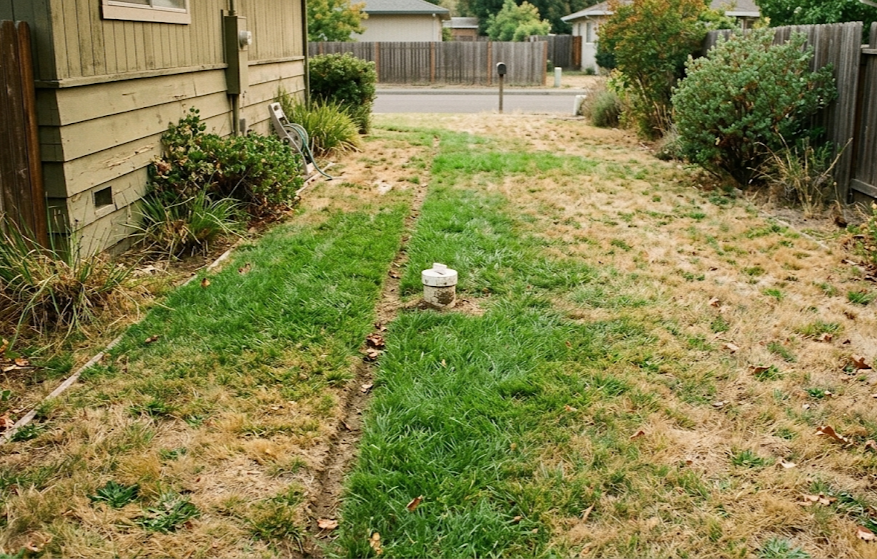
Once you have a general idea from records, a visual walkthrough of your property can reveal a lot. Here’s what to look for:
Walk the most direct path from your home’s main bathroom or kitchen (where the largest drain stacks are) toward the street or septic tank. Sewer lines typically run in a straight line with as few bends as possible.
Look for subtle clues in the landscape: slight depressions or raised ridges in the soil, greener grass along a certain path (indicating moisture from a leaking pipe), or previously disturbed ground that has settled differently from the surrounding area.
Identify the sewer cleanout. The cleanout is usually the most visible above-ground indicator of where the sewer line runs. It’s a capped pipe, typically 4 inches in diameter, that protrudes from the ground. Once you find the cleanout, you know the approximate path of the line between the house and the street.
Longtime neighbors or previous owners of the property sometimes have knowledge about the sewer layout that isn’t documented anywhere. If you’re friendly with a neighbor whose house was built around the same time as yours, comparing notes can be surprisingly helpful. Many subdivision-era homes in Ukiah were built with similar layouts, and if your neighbor knows where their line runs, yours is probably in a similar position.
The most accurate non-invasive method for finding a sewer line is a professional camera inspection combined with a pipe locating transmitter. Our sewer line services team inserts a camera equipped with a transmitter into the line through an accessible drain or cleanout. As the camera travels through the pipe, we use a handheld locating device above ground to track its position in real time.
This approach gives us a precise map of where the sewer line runs across your property, including depth at various points. It’s by far the most reliable method and has the added benefit of showing us the inside condition of the pipe at the same time.
For Ukiah homeowners planning major excavation, landscaping, or a renovation that might affect underground utilities, this is the method we recommend.
Knowing the terminology helps when working with plumbers or reviewing property records.
The building drain is the pipe inside your home that collects wastewater from all your fixtures and exits through the foundation wall.
The sewer lateral is the pipe that runs from your house exterior to the municipal main or septic tank. You are responsible for this section of pipe.
The connection point is where your lateral meets the city sewer main, typically located at or near the street. The city owns and maintains the main, but the lateral up to that point is your responsibility.
The cleanout is the access point on the lateral, usually located within a few feet of the house or at the property line.
Once you’ve identified where your sewer line runs, document it. Take photos, make a sketch with measurements, and consider recording the location in a home records file for future reference. If the line runs near a tree or is in an area you plan to develop, share the location with any contractors or landscapers before work begins.
Consider having the line inspected while you have access. Our camera inspection service can tell you whether the pipe is in good condition or has issues like root infiltration, cracks, or buildup that should be addressed. Catching problems early is always less expensive than dealing with a full emergency later.
If you discover the line is deteriorating, cracked, or has significant root intrusion, our emergency plumbing team can assess the damage and recommend the right repair approach, whether that’s spot repair, pipe relining, or full replacement.
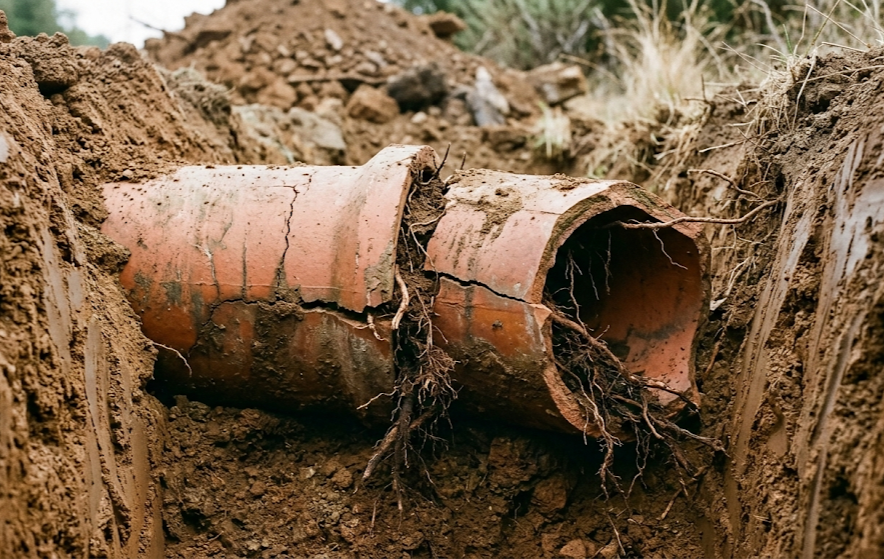
Homes in Ukiah built before the 1970s often have clay tile or cast iron sewer laterals. These materials were standard at the time but are now well past their design life in many cases. Clay tile is particularly susceptible to tree root intrusion and cracking, and cast iron corrodes over time.
If you have an older home and haven’t had your sewer line inspected in several years, or ever, scheduling an inspection while you’re already looking into the line’s location is a smart move. Northern California’s seasonal rainfall patterns and the clay-heavy soils common in parts of Mendocino County put added stress on older sewer pipes.
In Ukiah and most of California, residential sewer laterals are typically installed 18 inches to 3 feet below grade. The depth depends on when the home was built, local code requirements at the time, and the terrain of the property. Sewer lines must have sufficient cover to prevent freezing and damage, but in Northern California’s mild climate, depths tend to be on the shallower end.
In many cases, yes. Checking city records, reviewing permit history, and doing a visual inspection of your property can give you a reasonable idea of where the line runs. For a definitive, precise answer, however, a professional camera inspection with a locating transmitter is the gold standard.
In Ukiah and throughout California, the property owner is responsible for the sewer lateral from the home to the point where it connects to the city main. This includes any repairs or replacements needed on that section. The city is responsible for the main sewer line running under the street.
Call 811 before any digging to have public utility lines marked. Then, use the methods described in this guide to determine where your private sewer lateral runs. When in doubt, use hand tools instead of powered equipment near the area you think the line runs.
If you suspect you’ve hit a sewer line, stop digging and call a plumber immediately. Signs include sewage odor, wet or saturated soil, or visible pipe material. A damaged sewer lateral can cause backups inside the home and needs to be repaired promptly to comply with local health codes.
The cost varies depending on the length of the line and what’s involved. Call us at (707) 200-3159 for current pricing. A camera inspection is typically one of the most cost-effective ways to get accurate information about your sewer line’s location and condition.
When you’re ready to find your sewer line with certainty, or if you’re dealing with a sewer problem that needs professional attention, the team at AAA Organized Plumbing is here to help. We serve homeowners throughout Ukiah and Mendocino County with comprehensive sewer services. Call us at (707) 200-3159 or contact our team to schedule an inspection.
AAA Organized Plumbing is a licensed plumbing company serving Ukiah, Mendocino County, and the greater Northern California region. We specialize in sewer line inspections, repairs, and replacements, as well as a full range of residential plumbing services.
Our team is familiar with the unique plumbing characteristics of Ukiah’s housing stock and surrounding communities. We offer honest assessments and practical solutions for every plumbing challenge. Reach us at (707) 200-3159 or at 1252 Airport Park Blvd STE A4, Ukiah, CA 95482.
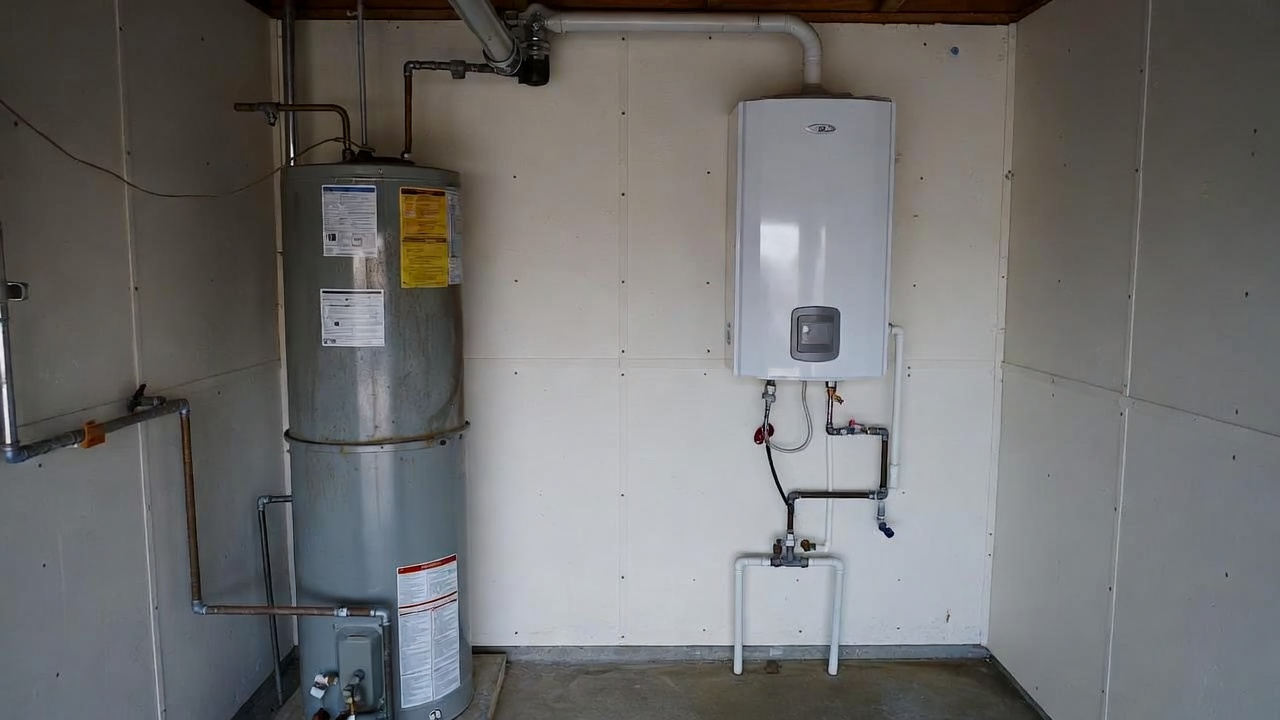
If your water heater is reaching the end of its life or you’re planning a home renovation, the question of tankless vs. tank water heater is one you’ll need to answer. Both types have real advantages, and the right choice depends on your household size, usage patterns, home setup, and budget. In Northern California, homeowners…
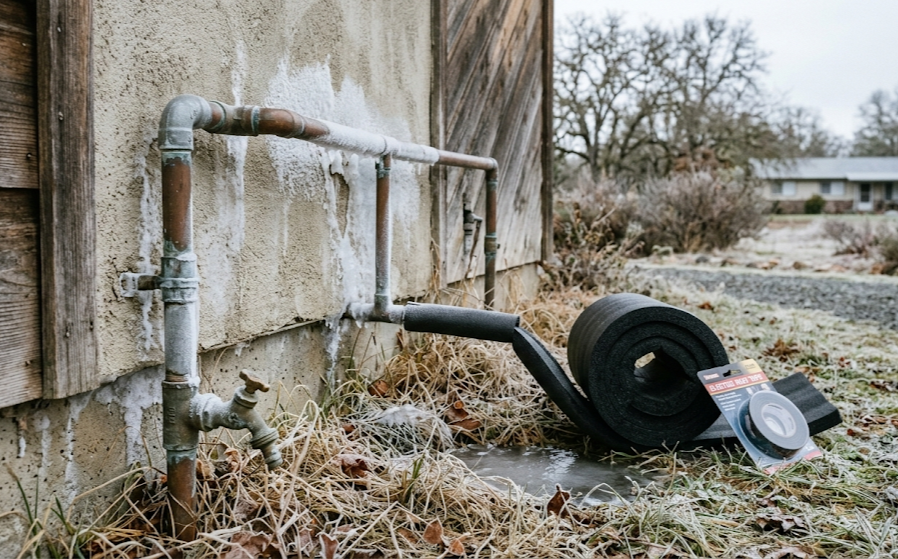
Northern California’s climate is generally mild compared to colder regions of the country, but Mendocino County winters can bring freezing temperatures, particularly in inland communities like Ukiah and Willits. When temperatures drop below 32 degrees Fahrenheit, water pipes in unprotected areas of your home, including crawl spaces, attics, garages, and exterior walls, are at genuine…
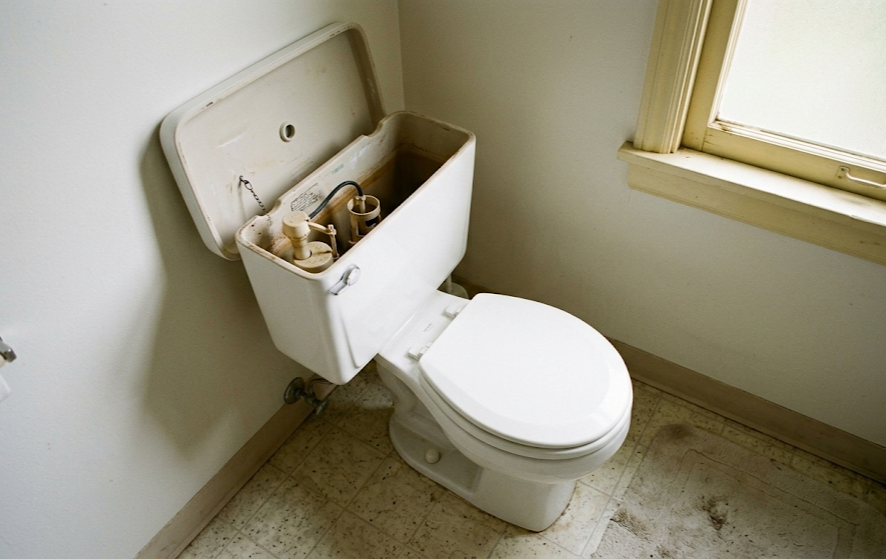
Opening the lid of your toilet tank to find it empty is one of those moments that stops you in your tracks. Whether you lifted the lid to troubleshoot a weak flush or you simply noticed the toilet isn’t refilling after use, a tank with no water is a problem that needs attention. For homeowners…
